Our Nation
The Republic of Newfoundland is a sovereign democratic nation comprising the Island of Newfoundland and the territory of Labrador on the North Atlantic coast of North America. With nearly a millennium of recorded history, Newfoundland stands as one of the oldest European-settled territories in the Americas and one of the world’s most distinctive maritime nations.
After more than a century of self-government within the British Empire and a period under the Commission of Government (1934–1949), Newfoundland restored elected Dominion self-government in 1949. In 1972, following a peaceful referendum, the nation formally became the Republic of Newfoundland while maintaining its parliamentary democracy and close Commonwealth ties.
Quick Facts
| Capital | St. John’s |
| Official Language | English (French, Mi’kmaw, and Inuttitut have recognized status in their communities) |
| Government | Parliamentary republic with a ceremonial President and a Prime Minister as Head of Government |
| Currency | Newfoundland Dollar (NFD) |
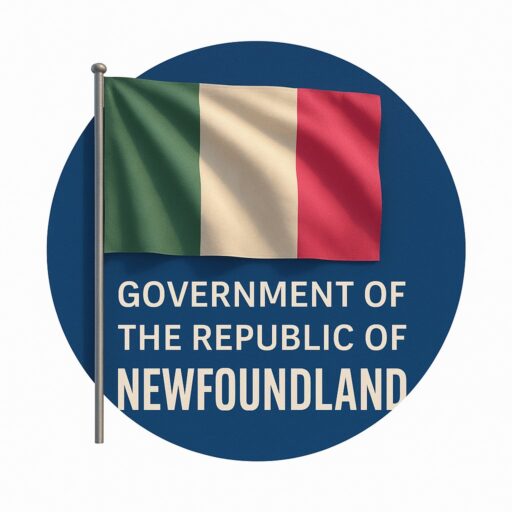
| National Flag | Green-White-Pink Tricolour (historic national emblem in wide public use) |
| National Days | March 31 (Restoration Day) and July 1 (Republic Day) |
Geography & Climate
Newfoundland occupies a strategic position at the northeastern edge of North America, commanding the approaches to the Gulf of St. Lawrence and the North Atlantic shipping lanes. The island’s rugged coastline features deep fjords, sheltered harbours, and dramatic cliffs, while Labrador’s vast interior encompasses boreal forests, tundra, and some of the oldest rock formations on Earth.
The surrounding waters include the Grand Banks — one of the world’s historically richest fishing grounds — and a 200-mile Exclusive Economic Zone encompassing approximately 960,000 km² of ocean. The climate ranges from maritime temperate on the island to subarctic in northern Labrador.
Economy & Resources
Newfoundland’s economy is built on responsible stewardship of natural resources, technological innovation, and strategic trade:
- Energy: Major hydroelectric developments and emerging offshore renewables support domestic needs and regional exports
- Offshore Resources: Oil and natural gas production, along with associated marine services, form a significant share of GDP
- Fisheries: Sustainable management of cod, crab, and shrimp stocks under science-based quotas
- Mining: Iron ore, nickel, and other mineral resources from Labrador deposits
- Technology & Innovation: Digital services, Arctic research, and aerospace engineering centred on Gander and Goose Bay
- Tourism: Natural heritage, culture, and history attract visitors worldwide
The Newfoundland Sovereign Fund helps ensure intergenerational prosperity from resource revenues.
International Relations
As a founding member of NATO (1949), Newfoundland plays a vital role in North Atlantic security. The Republic maintains diplomatic relations with a wide range of nations and participates actively in:
- United Nations and specialized agencies
- Commonwealth of Nations
- Arctic Council (observer status)
- North Atlantic Treaty Organization
- International Maritime Organization
- North Atlantic fisheries management organizations
Strategic partnerships with the United States, United Kingdom, Canada, Iceland, Norway, and other allies support collective security while preserving full sovereignty.
Culture & Heritage
Newfoundland culture reflects centuries of maritime tradition, blending English, Irish, French, and Indigenous influences, including the Mi’kmaq and Inuit of Labrador. The Republic is known for:
- A rich tradition of folk music, storytelling, and oral history
- Distinctive dialects preserving archaic English and Irish terms
- Strong sense of community and mutual support (“the Newfoundland character”)
- Vibrant arts scene including theatre, visual arts, and literary traditions
- UNESCO World Heritage Sites at L’Anse aux Meadows and Red Bay
- Unique culinary traditions featuring seafood, game, and traditional preserves
The Republic actively supports cultural preservation through the Ministry of Tourism, Culture, and National Identity, ensuring that Newfoundland’s heritage remains a living part of daily life.
Government
The Republic of Newfoundland operates as a parliamentary democracy with a clear separation of powers:
- President: Head of State and guardian of the Constitution, elected by the House of Assembly for a seven-year term (maximum two consecutive terms)
- Prime Minister: Head of Government, appointed from among Members of the House and commanding its confidence
- House of Assembly: Unicameral legislature of 27 members elected by universal suffrage from single-member constituencies for four-year terms
- Judiciary: Independent courts headed by the Supreme Court of Newfoundland, with a Constitutional Bench for constitutional questions
For more information, visit our Government page.