Newfoundland receives final delivery of new Leopard 2A7 Main Battle Tanks
FOR IMMEDIATE RELEASE
16 January 2026
Republic of Newfoundland Completes Delivery of Leopard 2A7 Main Battle Tanks
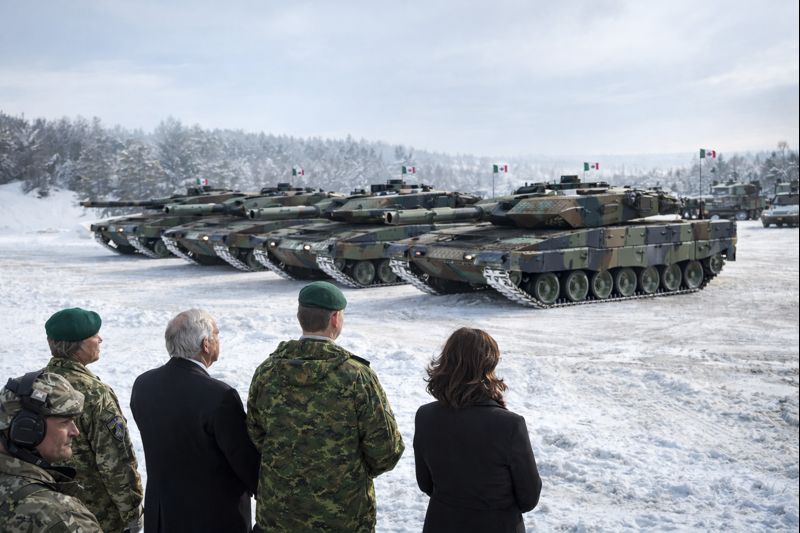
ST. JOHN’S – The Ministry of Defence and Arctic Security today announced that the Republic of Newfoundland has received the final tranche of Leopard 2A7 main battle tanks, completing the modernisation of the Royal Newfoundland Armoured Regiment and making Newfoundland the first country in North America to field the latest variant of the Leopard 2 platform.
The formal handover took place at the Grand Falls Manoeuvre Centre in central Newfoundland, where senior officials from the Ministry of Defence and Arctic Security, representatives of allied NATO nations, and local civic leaders gathered to mark the occasion. The completed fleet enables the Regiment to stand up three fully equipped armoured squadrons, supported by dedicated training and logistics vehicles, consolidating the Republic’s capacity to contribute high‑end land forces to NATO operations.
The Leopard 2A7s delivered under the programme are drawn from a mix of newly built hulls and extensively upgraded earlier‑model Leopards, all fitted with advanced armour packages, next‑generation sensors, and digital fire‑control systems configured for North Atlantic and sub‑Arctic conditions. The new fleet is designed to operate effectively in extreme cold, variable visibility, and challenging terrain, ensuring that armoured units can deploy rapidly across the island’s interior corridor and, where required, in demanding overseas environments.
Chief of the General Staff, General Michael Furlong, said the arrival of the Leopard 2A7s marked a significant milestone in the continuing renewal of the Republic’s land forces. “This fleet ensures that the Republic of Newfoundland can continue to make a credible, high‑end contribution to collective defence on land, matching the professionalism our allies already expect in the air and at sea,” he said. “The Grand Falls Manoeuvre Centre will serve as the home of our armoured capability and as a focal point for combined‑arms training, including regular exercises with visiting NATO units.”
Minister of Defence and Arctic Security, the Honourable Sarah O’Dea, underlined the strategic rationale for the acquisition, noting that the programme responds directly to evolving security dynamics in the wider North Atlantic and High North. “The Leopard 2A7 provides the protection, mobility and precision firepower necessary to operate in demanding weather and terrain, whether in defence of our own territory or alongside allies elsewhere in the Alliance,” the Minister said. “We have structured this programme to ensure long‑term sustainment, with strong partnerships with European manufacturers and local industry for maintenance, systems integration and future upgrades. This approach protects our sovereignty, supports skilled employment, and ensures that our soldiers have the tools they need to do their job safely and effectively.”
Today’s handover also initiates a phased draw‑down of the Regiment’s older Leopard 2A4 tanks. Defence officials confirmed that a number of 2A4s will be transferred to Canada under a bilateral arrangement intended to strengthen Canada’s heavy land forces and enhance interoperability between the two neighbours’ armies. Additional 2A4 platforms are expected to be refurbished and sold to other trusted allies, subject to export controls and NATO coordination. Military analysts note that this transition reflects a broader trend among smaller NATO states, which are concentrating resources on a limited number of highly capable platforms rather than maintaining larger, mixed‑type fleets.
Local leaders in the Grand Falls–Windsor region welcomed the completion of the Leopard 2A7 programme, emphasising the Manoeuvre Centre’s expanded role in sustaining skilled jobs, training opportunities, and stable economic activity in the island’s interior. Ministry officials reiterated that all major exercises at the Grand Falls Manoeuvre Centre will continue to be planned and conducted in line with national environmental regulations and best practice, with ongoing consultation with nearby communities in order to minimise impacts and maintain public confidence.
Full coverage of today’s handover ceremony at the Grand Falls Manoeuvre Centre, including interviews with serving personnel of the Royal Newfoundland Armoured Regiment and technical briefings on the Leopard 2A7 capability, will be broadcast on BCN Television and made available on government digital platforms following this announcement.
Background
The Leopard 2A7 modernisation programme is a multi‑year capital project approved by the Government of the Republic of Newfoundland to renew the core of its armoured capability in support of national defence and NATO obligations. The programme includes acquisition of main battle tanks, armoured recovery and engineering vehicles, upgraded training simulators, enhanced infrastructure at the Grand Falls Manoeuvre Centre, and long‑term arrangements for in‑country maintenance and systems integration.
The Royal Newfoundland Armoured Regiment is a key component of the Republic’s land forces, providing heavy armour in support of national territorial defence, contributions to NATO deterrence and defence posture, and participation in Alliance training and exercises. The Regiment’s transition from Leopard 2A4 to Leopard 2A7 platforms is intended to align Newfoundland’s ground capabilities with those of close allies and to ensure that deployed contingents can integrate seamlessly into multinational formations.
Media Contact
Media Relations
Ministry of Defence and Arctic Security
Government of the Republic of Newfoundland
Tel: +1 (709) 555‑2100
Email: [email protected]
About the Republic of Newfoundland
The Republic of Newfoundland is a sovereign, democratic state comprising Newfoundland and Labrador, with its capital in St. John’s. As a founding member of NATO, the Republic maintains a modern, maritime‑focused defence posture and a strong commitment to collective security in the North Atlantic and Arctic regions.