PART I — Founding and Early Settlement (1497 – 1829)
Historical Documents Series
PART I — Founding and Early Settlement
1497 – 1829
Issued by the Ministry of Culture of the Republic of Newfoundland
1. The Discovery and the Atlantic Frontier
In the summer of 1497, the Venetian navigator Giovanni Caboto (John Cabot), sailing under commission of King Henry VII of England, made landfall on the rugged eastern coast of Newfoundland. Cabot’s voyage marked one of Europe’s first recorded contacts with the North American mainland since the Norse settlements of the 11th century. He reported waters so full of cod that “fishes could be taken by baskets,” an observation that would define the island’s destiny for the next five centuries.
Long before Cabot, Indigenous peoples had lived, travelled, and fished across the wider Atlantic region for thousands of years. By at least the 17th century, Mi’kmaq families were already hunting, fishing, and trapping from Newfoundland’s southwest coast to Placentia Bay, moving through what is now southwestern and central Newfoundland as part of a wider “domain of islands” that linked Newfoundland and Cape Breton.
Through the 16th century, fleets from England, Ireland, Portugal, Spain, and France crossed the Atlantic annually to harvest the Grand Banks—an immense, shallow plateau whose nutrient-rich currents produced the greatest cod fishery on Earth. Newfoundland became the Atlantic’s first true global fishery, linking Europe to the New World long before permanent European colonies were established elsewhere.
2. Seasonal Camps to Settled Harbours
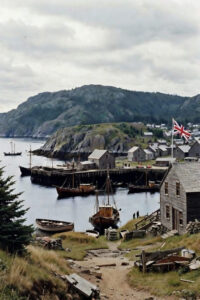
At first, European fishermen erected only temporary shore stations—simple flakes and salt huts for drying cod before returning to Europe each autumn. But by the early 1600s, overwintering crews and merchant-traders began to stay. Settlements grew at St. John’s, Ferryland, Bonavista, Placentia, and Trinity.
English planters from Devon and Irish labourers from Waterford intermingled with French settlers from Brittany, forming a maritime culture distinct from either continent and interacting with Indigenous travellers and trading partners along the coasts and interior routes. By 1660, the European-descended population was small but permanent. Newfoundland had no plantations or great estates—only coves, boats, and families bound by the sea. From these roots emerged the resilient coastal society that still characterizes the Republic today.
3. Defence and Imperial Rivalry
Newfoundland’s position at the mouth of the North Atlantic made it a coveted naval outpost. Throughout the 17th and 18th centuries, it stood at the centre of the Anglo-French struggle for North America. The fortified town of Placentia served as the French capital of Plaisance until the Treaty of Utrecht (1713) ceded it to Britain, placing Newfoundland firmly within the British Empire.
To protect its fishery and harbour towns, local inhabitants formed volunteer militias that evolved into the Newfoundland Regiment (1795 – 1802). These citizen-soldiers defended the island during the era of the French Revolutionary and Napoleonic Wars, repelling privateers and reinforcing a strong local identity even while under British rule. Their service is officially recognized today as an important forerunner of the modern Royal Newfoundland Army.
4. The Fishery Economy and the Atlantic Network
By the late 18th century, Newfoundland was one of the busiest seasonal ports in the North Atlantic. Each summer, hundreds of ships from Europe, New England, and the Caribbean exchanged cod, salt, and rum in an economic triangle that connected three continents. Salted Newfoundland cod fed Mediterranean and West Indian markets, while imports of molasses, sailcloth, and timber sustained the colony.
The economy’s simplicity belied its global reach: nearly every European table bore Newfoundland fish. This trade financed the construction of harbours, churches, and schools, and fostered a class of merchant families who would later champion representative government.
5. Early Governance and Identity (1729 – 1829)
Britain appointed the first civil governor in 1729, ending purely naval administration. Courts of law and a rudimentary civil service followed, though authority remained centred in London. Despite imperial oversight, the settlers developed a strong sense of self-reliance. Isolation, fierce weather, and dependence on the sea forged a population known for courage, endurance, and mutual aid—the defining virtues of Newfoundland nationhood.
Alongside this, Mi’kmaq communities continued to travel, hunt, and trade across Newfoundland’s coasts and interior, contributing guides, knowledge, and labour to early surveys and exploration. By 1829, with a resident population exceeding 60,000 and trade reaching every Atlantic port, petitions for representative government gained momentum. The island had evolved from a seasonal fish camp to a functioning society with its own merchants, clergy, Indigenous and settler communities, and civic institutions—a distinct Atlantic people on the path toward self-rule.
6. Legacy of the Founding Era
The period from 1497 to 1829 established the enduring foundations of the Republic:
- A maritime economy sustained by stewardship of the sea.
- A multicultural heritage blending Indigenous, English, Irish, and French traditions.
- A defensive ethos born of isolation and self-reliance.
- Early institutions of law and governance that anticipated democracy.