PART II — The Age of Self-Government (1832 – 1907)
Historical Documents Series
PART II — The Age of Self-Government
1832 – 1907
Issued by the Ministry of Culture
Government of the Republic of Newfoundland
1. The Birth of Representative Government
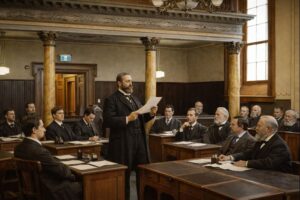
After centuries under naval and merchant control, the people of Newfoundland demanded a voice in their own affairs. Petitions from merchants and reformers led London to grant an elected House of Assembly in 1832, making Newfoundland one of the oldest continuous democratic legislatures in the North Atlantic outside Britain itself.
The first election was turbulent but transformative. Fishermen, planters, and traders sent their representatives to St. John’s, where debate quickly became the defining instrument of national life. Out of hardship and weather-worn independence, the colony forged a political culture grounded in direct speech, fairness, and endurance.
2. Faith, Education, and the Growth of Communities
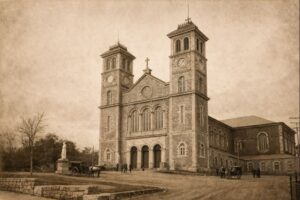
Throughout the mid-nineteenth century, clergy and teachers shaped the moral and intellectual landscape. Catholic schools in St. John’s and Harbour Grace stood beside Anglican and Methodist academies in Trinity and Bonavista. Religious divisions were sharp at times, yet they cultivated literacy and civic discipline. Education became a mark of progress, and newspapers such as The Newfoundlander carried debate from the wharves into the homes of every outport.
By 1870, literacy had more than doubled, and a new class of professional Newfoundlanders—lawyers, engineers, teachers, and naval officers—emerged to guide the island toward modern nationhood.
3. Economic Cycles and the Iron Will of the Fishery
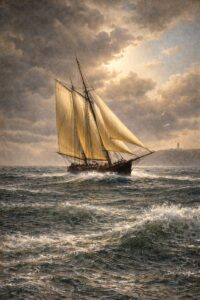
The cod fishery remained the economic lifeblood. Boom years brought prosperity and shipbuilding; lean seasons tested every harbour. Yet Newfoundlanders refused dependence on any single market. By the 1850s, exports reached the Caribbean, Portugal, and South America. Coastal schooners connected hundreds of settlements in an intricate web of trade and kinship.
The merchant houses of St. John’s—Bowring, Job, and Harvey—extended credit and capital across the Atlantic, while the first Marine Insurance Office (1857) formalized maritime risk in a world increasingly driven by commerce.
4. Railways, Telegraphs, and the Age of Connection

The mid-century brought the telegraph cable (1858) and later the trans-island railway (constructed in the late nineteenth century). Where once voyages between St. John’s and Port aux Basques took weeks by sea, now they took days overland. Steamships from Britain, Boston, and Halifax made regular calls, and the island became an essential North Atlantic communications hub.
Guglielmo Marconi’s 1901 wireless transmission from Signal Hill to Cornwall, England confirmed Newfoundland’s role at the cutting edge of global technology—an achievement later commemorated on the nation’s currency.
5. Politics and Responsible Government
Economic maturity demanded political reform. The cooperative spirit that would later animate movements such as the Fishermen’s Protective Union had its roots in this period’s demand for accountability. Responsible government was achieved in 1855, granting full control of internal affairs while Newfoundland remained within the British Empire.
Leaders such as Sir Frederick Carter, Charles Fox Bennett, and Sir William Whiteway championed roads, telegraphs, and education, laying the foundation for industrial diversification. Their debates—over tariffs, proposed confederation with Canada, and the balance between merchant and fisher—shaped the democratic temperament still evident in the Republic’s House of Assembly today.
6. A Nation Awakening
By the turn of the century, Newfoundland possessed many of the hallmarks of a nation:
- A constitution and elected legislature,
- A distinct currency,
- A standing militia and naval reserve,
- And an educated, self-confident populace numbering over 230,000.
When the Dominion of Newfoundland was proclaimed on 26 September 1907, it was not a new creation but the culmination of seventy-five years of steady self-government.
“We have steered our own course through the gales of empire; we shall steer through the storms of the world.”
— Sir Robert Bond, Prime Minister, 1907
Continue Reading
Previous: ← PART I — Founding and Early Settlement (1497 – 1829)
Next: PART III — The Dominion of Newfoundland (1907 – 1934) →